

Plymouth covers a lot of ground, and power reliability varies considerably from one part of town to another. Homes downtown near Water Street tend to come back on relatively quickly. Properties in Cedarville, Manomet, and the wooded stretches bordering Myles Standish State Forest often wait days after a serious nor’easter, and the coastal wind that comes off Plymouth Harbor and White Horse Beach takes limbs down with regularity.
That is the context most homeowners are working in when they start looking at backup power. Before scheduling an installation, there are six questions worth getting clear answers to. Working through them upfront produces a system that is correctly sized, properly permitted, and genuinely reliable rather than one that disappoints during its first real test.
What Types of Generators Are Available for Installation?
Not every category on the market is a serious candidate for whole-home backup, and knowing which is which narrows the decision quickly.
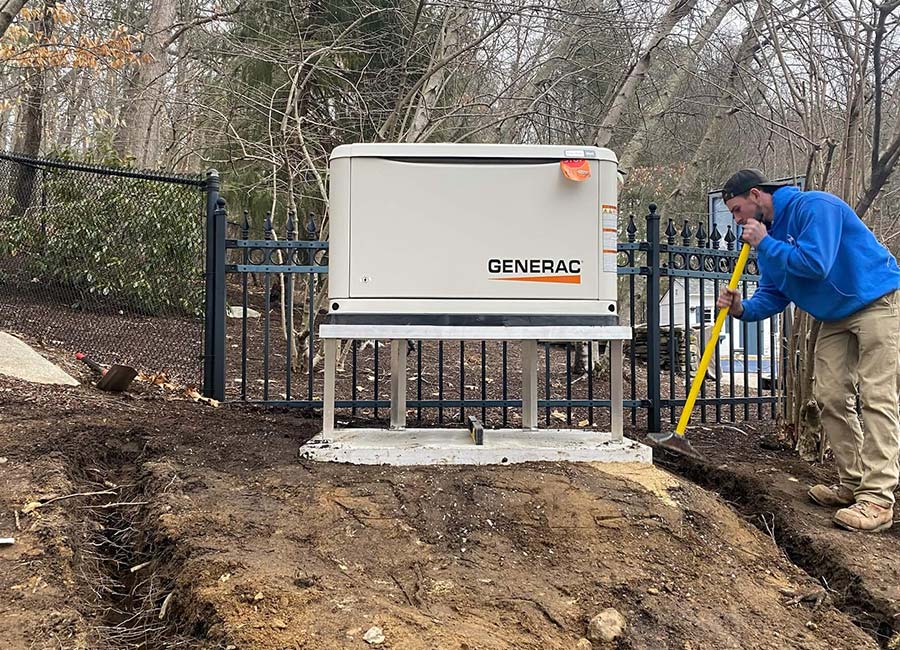
- Standby generators are permanently installed, wired into the home’s electrical system through an automatic transfer switch, and fueled by natural gas or propane. They start on their own within seconds of an outage and shut down when utility power returns. For year-round residential backup, this is the category most Plymouth homeowners end up in.
- Portable generators are standalone gasoline units that power a limited set of loads and require someone present to start, refuel, and manage them. They serve a real purpose for occasional short outages and for households that only need to keep a few essentials going.
- Inverter generators produce cleaner power at lower noise levels and better fuel efficiency than conventional portables, which makes them well suited to sensitive electronics and recreational use. Their output is generally too limited for whole-home coverage.
- Commercial generators are built for continuous operation at capacities well beyond residential demand. Relevant for businesses along Route 3 and Long Pond Road, not for houses.
- Solar generators store battery power rather than producing it on demand. They run silently and emit nothing, but their runtime is fixed by battery capacity, which is a meaningful constraint during a multi-day winter outage with limited daylight.
Our generator installation in Plymouth service covers both the standby and portable side, and the right recommendation depends on the property rather than the product.
How Do I Determine the Right Size Generator for My Home?
Sizing is the single most consequential decision in this process. An undersized unit stalls under load when it matters most. An oversized one costs more to buy, install, and run than the house will ever use.
Assess Power Requirements
Proper sizing begins with an inventory of what has to stay running. For most Plymouth households that includes refrigeration, the heating system and its controls, well and septic pumps on the many properties in South Plymouth not on town utilities, sump pumps, lighting, communications equipment, and any medical devices in the home.
The part homeowners cannot accurately estimate on their own is starting load. Motor-driven equipment such as well pumps, furnace blowers, and air conditioning compressors briefly draws several times its running wattage at startup. A generator sized to running numbers alone will trip the first time the well pump cycles. An electrician performs a load calculation that accounts for those surges, for how loads overlap in real use, and for headroom to accommodate future additions.
Consider Home Size
Square footage is a rough starting point rather than a sizing method. As a general frame of reference, homes under 1,500 square feet often land in the 5,000 to 7,500 watt range, while larger homes commonly require 10,000 watts or more. Those figures shift substantially based on fuel type for heat, whether the home is on a well, and how much of the house the owner wants covered.
Layout matters as much as size. The whole house generator approach covers the full panel, while a managed-circuit configuration protects a designated priority set at a lower cost. For a seasonal property or a household that only needs refrigeration and a few outlets during short outages, a portable generator may be a reasonable fit. A site evaluation settles which configuration makes sense.
What Is My Budget for a Generator Installation?
A realistic budget accounts for four categories rather than the equipment price alone.
- Equipment. Cost scales with output capacity, enclosure quality, and controller features such as remote monitoring.
- Installation labor. Driven by site complexity: distance from the panel to the unit, gas line routing, pad preparation, and the condition of the existing electrical service.
- Permits and inspections. Municipal fees for electrical and gas permits, plus the inspections required before the system can be commissioned.
- Ongoing ownership. Annual service, fuel consumption during operation, and eventual component replacement such as batteries.
There is often a fifth line item that surprises people. If the existing service or panel cannot support an automatic transfer switch or lacks the capacity the installation requires, an electrical panel upgrade becomes part of the project. Identifying that during the estimate rather than mid-installation is one reason a proper site assessment matters. Financing is available for households spreading a larger project across a longer horizon.
What Are the Local Regulations and Permits Required in Plymouth, MA?
Generator installations in Plymouth are regulated work, and the requirements are not optional.
Expect the following to apply:
- Electrical permit filed with the Town of Plymouth, with work performed under a licensed electrician and inspected before commissioning.
- Gas permit and inspection for the fuel connection, whether tying into a natural gas service or an on-site propane tank.
- Zoning and setback compliance, which governs how close a unit can sit to property lines and structures.
- Noise limits, which affect placement and enclosure selection, particularly in the denser neighborhoods near downtown and in Pinehills where association rules may add further restrictions.
- Conservation review on properties near wetlands, coastal banks, or the ponds throughout West Plymouth, where local conservation commission approval can be required before ground is disturbed.
A licensed contractor files these, schedules the inspections, and coordinates with the utility. Unpermitted generator work creates problems at resale and can give an insurer grounds to deny a claim.
How Will the Installation Process Work?
A standard residential standby installation follows a predictable sequence, and knowing the stages helps set expectations on timing.
- Site assessment. An electrician evaluates the panel and service capacity, performs the load calculation, identifies a compliant location for the unit, and maps the gas and electrical routing.
- Permitting. Applications are filed with the town and, where applicable, with the conservation commission. This stage often determines the overall project timeline.
- Site preparation. The pad is set, the gas line is run and pressure tested, and the electrical rough-in is completed.
- Installation. The unit is placed and connected, and the automatic transfer switch is installed at the panel and wired to the service.
- Inspection. Town electrical and gas inspectors sign off on the completed work.
- Commissioning and testing. The system is started, run under load, and verified to transfer correctly both on outage and on restoration. The homeowner is walked through operation, controls, and what the indicator lights and alerts mean.
What Maintenance and Support Options Are Available After Installation?
A standby generator spends nearly all of its life idle, which is precisely why service coverage determines whether it works on the day it is needed.
Worth confirming before you sign:
- What the maintenance plan includes. A thorough annual service covers oil and filter changes, spark plugs, battery testing and replacement, transfer switch inspection, and operation under actual load rather than a no-load start.
- Warranty terms. Manufacturer coverage varies by model and length, and extended options are often available. Clarify what is covered on parts versus labor and what maintenance records are required to keep coverage valid.
- Emergency response availability. A generator that fails during a storm needs a company that answers the phone at two in the morning. Twenty-four hour emergency service is part of what we provide.
- Remote monitoring. Many current units report status and faults automatically, which means a failed self-test gets noticed before the next outage instead of during it.
- Homeowner orientation. Understanding the control panel, the exercise schedule, and how to interpret alerts lets you flag a developing issue early without ever opening the unit.

Preparing Your Plymouth Home for the Next Outage
The value of working through these six questions is that they surface the decisions that are expensive to change later. Sizing, placement, permitting, and service coverage all get locked in at installation, and correcting any of them afterward costs considerably more than getting them right the first time.
If your property depends on a well or septic pump, if your street has a history of extended restoration times, or if the house sits empty for stretches during the winter, automatic standby power is likely the direction to go. If outages are short and someone is reliably home, a smaller solution may serve you well. Either way, the answer should come from a look at your actual property rather than a product comparison.
Crowe Electric handles generator work across Plymouth and the surrounding South Shore, from the site assessment through permitting, installation, and ongoing service. When you are ready to talk through what your home needs, contact our team today and we will set up an evaluation.