

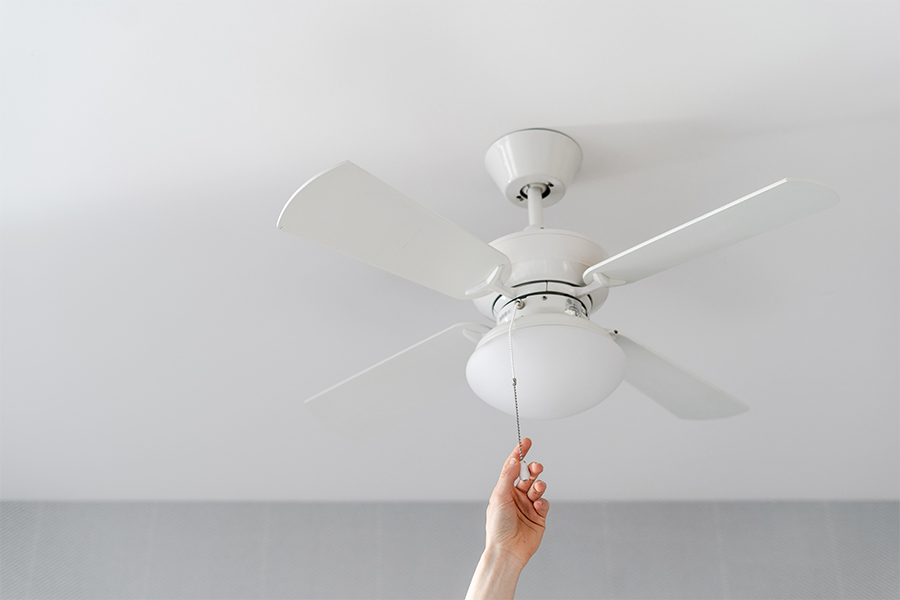
A ceiling fan uses up to 80 watts on its own, and a fan with a built-in light can draw up to 200 watts with the light on. Run an 80-watt fan for eight hours overnight and it uses just 0.64 kilowatt-hours, far less energy than running an air conditioner for the same stretch.
As a top electrician in Scituate, MA, our team helps homeowners get the most comfort out of every watt. Here’s how to figure out what your fan actually costs to run and how to use it more efficiently.
Key Points
- Usage depends on the fan. Motor, blade speed, design, and whether the fixture doubles as a light all affect how much electricity it draws.
- Your exact cost is easy to calculate. Multiply the fan’s wattage by hours of use, divide by 1,000 to get kilowatt-hours, then multiply by the rate on your electric bill.
- Fans cool people, not rooms. They change how warm you feel rather than the room temperature, so switching them off in empty rooms saves energy.
- Fans and AC work best together. Running a fan lets you raise the thermostat a few degrees and eases the load on your cooling system.
As a top electrician in Scituate, MA, our experts are here to break down the answer. Find out how you can calculate your fan’s electrical consumption and make your home more energy-efficient in this guide.
The Type of Fan You Use Impacts Its Electricity Usage
Countless Scituate locals use free-standing or ceiling fans to increase air circulation throughout their homes. While both of these options serve the same purpose, they differ when it comes to overall efficiency. Free-standing fans cover a limited surface while ceiling fans move the air throughout the entire room.
Ceiling fans may consume more electricity, but this increase coincides with the amount of space they cover. Energy consumption also varies based on the fan’s features.
Some ceiling fans only have one function while others double as a light fixture. Your fixture’s design and capabilities directly impact the amount of electricity it uses. For example, basic ceiling fans use up to 80 watts of electricity per hour while those with lights consume as many as 200 watts per hour.
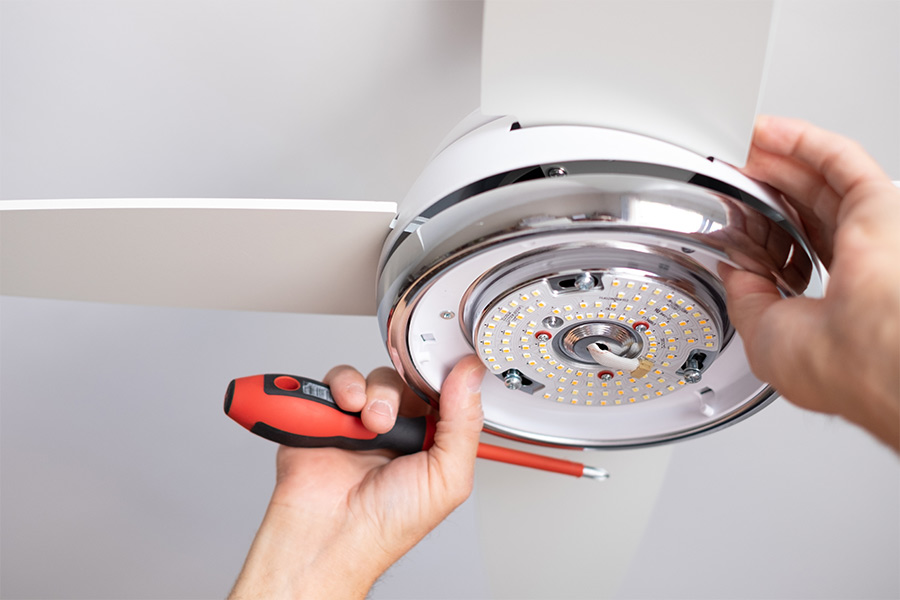
How to Calculate a Ceiling Fan’s Electrical Consumption
How much electricity does a ceiling fan use? The answer depends on a few key factors, including the design, blade speed, and motor capabilities. You can calculate your fixture’s average electricity consumption with a few simple steps.
Examine your home’s electric bill to find the rate per kilowatt-hour that your utility company charges. You should then check your fan’s label or manual to find its total wattage. Once you have these two figures, you can perform some quick calculations to figure out how much you’ll pay for operating your fan.
Let’s say that you have an 80-watt fan and an electric rate of $0.10 per kilowatt-hour. You let the fan run for eight hours every night while you sleep. What will this cost you?
Perform the following calculations:
- Multiply the fan’s wattage by the hours of use to get your total watt-hours.
- Divide the total watt-hours by 1,000 to determine the total kilowatt-hours.
- Take your kilowatt-hours and multiply it by your electric rate.
In this example, using the 80-watt fan for eight hours consumes 640 watt-hours or .64 kilowatt-hours. At a rate of $0.10 per kilowatt-hour, using your fan overnight will cost you $0.064.
Ceiling Fans vs. Air Conditioners for Home Comfort: Which Uses More Electricity?
How much electricity does a ceiling fan use compared to an air conditioner? Even Scituate locals with high electric rates per kilowatt-hour will use significantly less energy operating a ceiling fan over an air conditioning system. The average air conditioner uses 3,500 watts per hour, causing your electric bills to skyrocket while in use.
Given the scorching temperatures and high humidity that impacts the region during the summer, air conditioners remain necessary for cooling your home. However, you can also utilize ceiling fans to maintain your comfort and save money.
How Scituate Homeowners Can Make Ceiling Fan Usage More Energy-Efficient
Do you want to save even more on your energy costs? Experts recommend the following tips for efficient fan use:
- Install an Energy Star-rated model: These fixtures consume up to 60% less energy than conventional ceiling fans.
- Adjust the thermostat: Ceiling fans keep your home comfortable and reduce the strain on your cooling system. Increase the temperature on your thermostat a few degrees to ease energy consumption without compromising your comfort.
- Only use fans in occupied rooms: Contrary to popular belief, fans don’t lower the temperature of a room but rather affect your perception of the temperature. Save electricity by only operating them when you’re in that room.
- Maintain your fan: Clean the blades regularly and conduct proper maintenance to keep the fixture operating at maximum efficiency.
Contact Crowe Electric for Energy-Efficient Electrical Solutions in Scituate
Use the information above to answer the question, “How much electricity does a ceiling fan use?” If you’re looking to make your Scituate home more energy-efficient without compromising your comfort, turn to Crowe Electric.
We specialize in ceiling fan installation and can upgrade your electrical system to increase performance and save you money. Give us a call if you keep experiencing different electric circuit overload signs or need to install energy-saving fixtures.